
Blog
Building a Cut Flower Garden: Seven Bulbs That Keep the Vase Full

Most gardens are planted to look good from the window. A cutting garden is planted to be harvested — which means different spacing, different varieties and a different attitude to flowers that are past their best.
The advantage of bulbs is that they do the hardest part of the job in advance. You plant once, and for the next four months there is always something with a stem long enough to cut.
Plant for stems, not for the border
Cutting varieties are chosen for stem length, vase life and the number of flowers per stem. They are usually planted closer together than ornamental beds, in rows, so you can walk between them with a bucket. And they are cut hard — the more you cut, the more the plant produces.
Set aside a bed that gets at least six hours of sun, with good drainage and a water source nearby. A cutting garden without water nearby is a cutting garden you stop visiting in July.
Spring: ranunculus and anemone
Ranunculus and anemones are the backbone of the spring cutting garden. Plant the claws and corms in autumn in mild climates, or early spring in cold ones, and they will flower for six to eight weeks from mid-spring.
Cut ranunculus when the bud is just beginning to open — they continue to open in the vase. Anemones are best cut when the flower is fully open but before the centre turns fluffy. Both last a week or more in water.
Early summer: alliums and calla lilies
Alliums give you the architectural stems that flower arrangers pay a fortune for: a perfect sphere on a straight, leek-like stem. Cut them when half the florets have opened. They dry beautifully too, and can be kept for winter arrangements.
Calla lilies are slower to establish but incomparable in the vase — a single curled trumpet in a slim vase needs nothing else. Cut when the spathe has fully unfurled and the stem is firm.
Midsummer: lilies and gladiolus
Lilies are the most productive cut flower per square metre: one stem can carry five to eight flowers, and each opens over a week. Cut when the first bud is just colouring, not fully open, and remove the anthers before they shed pollen on your tablecloth.
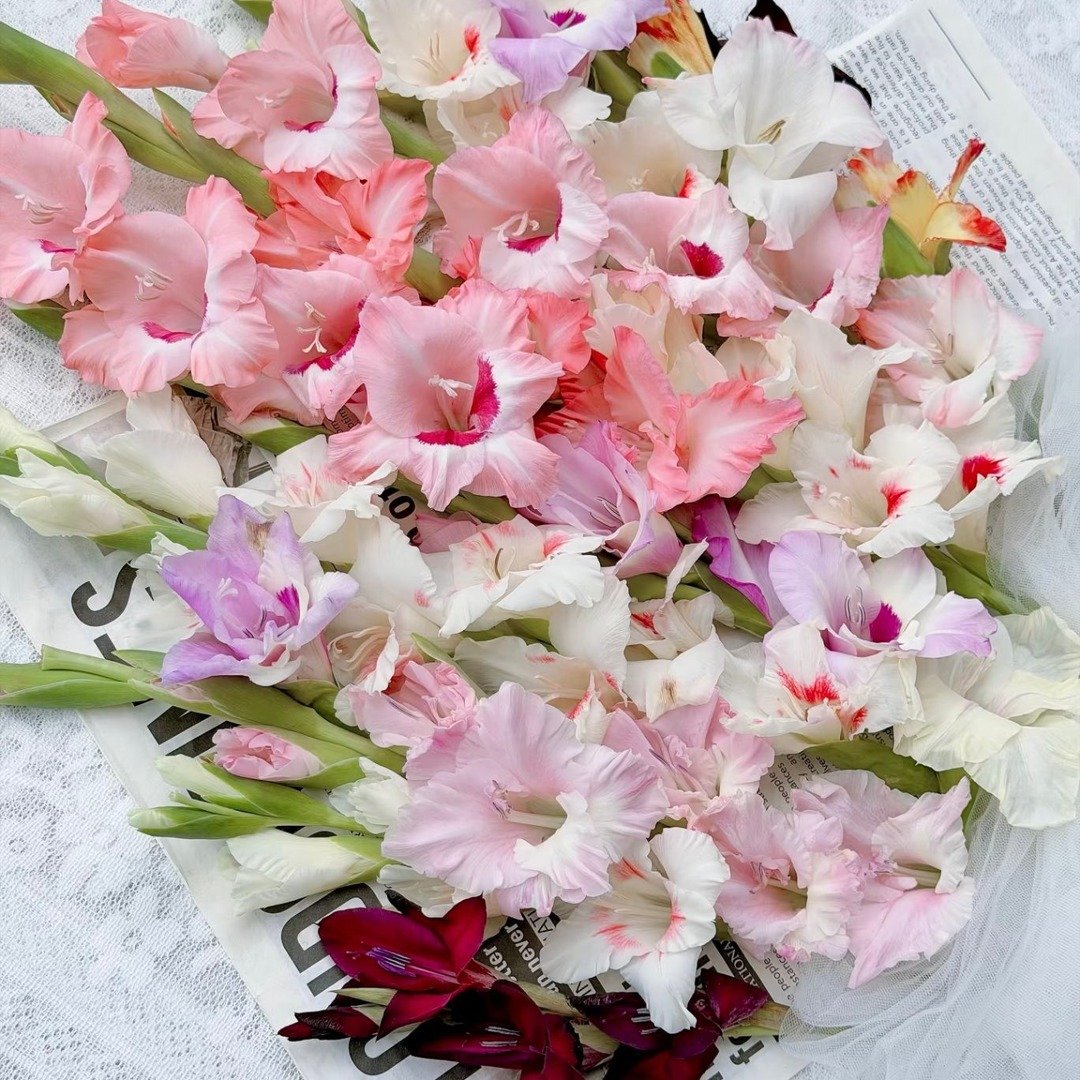
Gladiolus give you vertical spikes that fill a vase on their own. Cut when the bottom two or three florets are open; the rest will open in water. Plant a handful every two weeks for a succession.
Late summer: dahlias
Dahlias are the reason to keep a cutting garden going into autumn. A single plant can produce twenty stems in a season if you cut regularly — and cutting regularly is exactly what keeps it flowering. Cut when the flower is fully open but still firm, in the cool of the morning.
Succession sowing and spacing
- Plant in blocks, not single rows — blocks are easier to net against wind and easier to harvest.
- Stagger plantings two to three weeks apart for anything that flowers for a limited window: ranunculus, anemone, gladiolus.
- Space for airflow — closer than an ornamental bed, but not touching. Mildew loves a crowded cutting garden.
- Net or stake early — a stem that bends in wind is a stem you cannot sell or gift.
Harvesting and conditioning
Cut in the morning, when stems are full of water. Take a bucket of clean water into the garden with you and put stems straight into it. Cut at an angle so the stem does not sit flat on the bottom of the vase.
Strip the lower leaves before arranging — leaves under water rot and shorten vase life faster than anything else. Change the water every two days and re-cut the stems.
Seven bulbs to start with
Start with the Ranunculus Roots and Anemone Bulbs for spring, the Mixed Ornamental Onion Collection and Calla Lily Bulbs for early summer, then the Double Flowered Lily Bulbs and Elegant Gladiolus Bulbs for midsummer, finishing with Dahlia Bulbs in late summer.
Seven kinds, one bed, and a vase that is never empty between April and September. That is the whole case for a cutting garden.